
ACOUSTIC EMISSION CONTROL
It is based on the emission and registration of stress waves during rapid local restructuring of the material structure. Defects that occur and develop in the material during operation cause a concentration of deformations. If, during loading, the local strain (overvoltage) caused by the presence of a defect exceeds the threshold level for emission, acoustic emission occurs. The higher the deformation caused by the defect, the higher the emission level and the lower the load level at which it appears. The total energy of the emission is a measure of the risk of a defect. A defect located in a more stressed area of the object causes a higher stress concentration and higher emission than a similar defect located in a less stressed area. From the point of view of the structural integrity of the object, a defect located in a more loaded area is more dangerous than a similar defect in a less loaded area. Acoustic emission tests allow us to establish this difference.
The classical sources of AE are the processes of plastic deformation and fracture. The rapid movement (growth) of the AE source causes the appearance of stress waves that propagate in the material structure and reach the piezoelectric transformer. The electrical emission signals received as a result of the voltage wave conversion by the sensor are amplified, recorded by the equipment and subjected to further processing and interpretation.
Modern systems measure both individual parameters of an AE signal: amplitude, duration, energy, oscillations, time of arrival, time of rise, and other parameters related to its frequency characteristics, as well as the shape of the digitized signal. The analysis of the set of parameters of the sequence of AE signals makes it possible to determine the location of the source, its type and degree of danger. A detailed analysis of the shape/spectrum of the digitized signal is used to clarify the type of source and propagation characteristics of the signal.
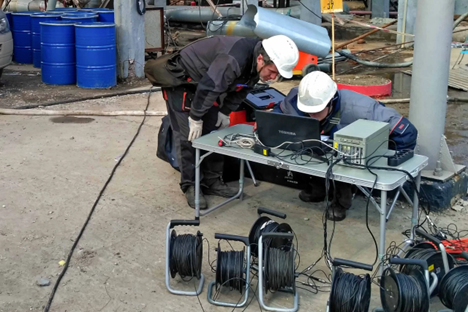 Since the source of acoustic emission energy is the field of elastic stresses in the material, AE control is usually carried out by loading the controlled object. This can be a pre-launch verification check, periodic monitoring during operation, or monitoring. Acoustic emission differs from most non-destructive testing (NDE) methods in three key aspects.
- The signal source is the material itself, not an external source, i.e. the method is passive (and not active, like most other control methods). This, in turn, leads to the fact that:
- Unlike other methods, AE detects developing, i.e. the most dangerous defects
- This method is remote, it does not require scanning the surface of the object to search for local defects, but only the correct placement of sensors on the surface of the object to locate the AE source
The opportunities associated with the remote use of the method offer great advantages over other control methods that require, for example, removing insulating shells, freeing control objects from internal contents, or scanning large surfaces. Due to the difference in their capabilities from traditional control methods, in practice it turns out to be very useful to combine AE with other methods. The use of the AE method significantly reduces the time of diagnostic work and saves money spent on their implementation and decommissioning of equipment.